
Openers That Lift Mountain Snow Weight
Garage Door Openers in Heber-Overgaard for new installations, motor rebuilds, and systems that fail under freeze-thaw stress and heavy winter loads
Your opener motor is the only component between you and a stuck garage door during a winter storm, and when it fails, you lose access to your vehicle or equipment until the system is repaired. The service involves installing new garage door openers, rebuilding existing motors by replacing worn gears and capacitors instead of discarding the entire unit, and diagnosing opener failures to determine whether the motor, the spring system, or the force adjustment is the root cause. Overgaardian Door Service installs and repairs garage door openers throughout Heber-Overgaard and the White Mountains, handling systems that must generate enough force to lift doors carrying ice buildup while still reversing safely when they contact an obstruction.
Opener installation and repair begins with matching the motor's horsepower to the door's weight and configuration. High-altitude conditions and winter snow loads demand robust opening force, but the system must also stop and reverse immediately if the door contacts something while closing. Installation includes mounting the motor unit to the ceiling or wall, connecting the drive mechanism to the door's lifting arm, wiring the unit to power and wall controls, and programming force settings and travel limits so the door opens and closes fully without overrunning or stopping short.
Arrange an opener evaluation to determine whether your current motor can be rebuilt or whether the system requires a new unit with updated safety features and higher lifting capacity.
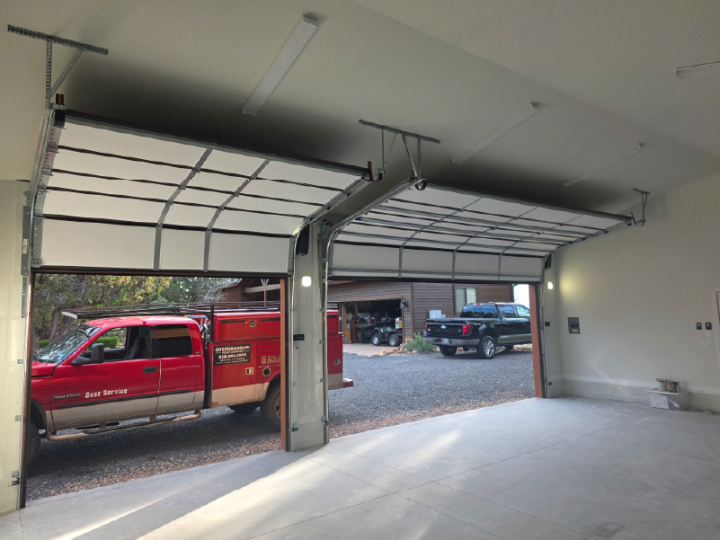
What Rebuilding Accomplishes Versus Replacement
Many opener motors fail because a single internal component wears out, not because the entire unit has reached the end of its useful life. Gears strip under repeated stress, capacitors lose charge and prevent the motor from starting, and drive belts stretch or crack from temperature cycling. Rebuilding involves disassembling the motor housing, identifying the failed component, and replacing it with a new part while retaining the functional motor, circuit board, and housing. This approach costs less than buying a new opener and extends the life of systems that still have years of operation left in their core components.
After installation or rebuild, your opener responds immediately when you press the remote or wall button, the door lifts smoothly without jerking or stalling midway, and the motor runs quietly without the grinding or clicking noise that signals worn gears. The system reverses correctly when the door contacts an obstruction during closing, which prevents damage to the door and injury to people or pets. Force adjustment ensures the motor applies enough power to lift the door even when ice has added weight, but not so much power that it damages the door or fails to reverse when needed.
Opener diagnostics separate motor failures from spring failures, which produce similar symptoms but require different repairs. Testing involves disconnecting the motor and manually lifting the door: if the door lifts smoothly and stays in place, the springs are functional and the motor is the problem, but if the door feels extremely heavy or drops immediately, the springs have failed and the motor has been struggling against excessive weight.
Common Questions About This Service
Homeowners facing opener problems often ask about repair costs, compatibility with existing doors, and how to choose between repair and replacement.
What causes garage door openers to fail more often in Heber-Overgaard?
Freeze-thaw cycles stress motor components by repeatedly expanding and contracting metal and plastic parts, heavy winter snow loads force the motor to work harder and wear out faster, and high-altitude conditions affect how well the motor dissipates heat during extended operation.
How do you decide whether to rebuild or replace an opener motor?
If the motor housing, drive mechanism, and circuit board remain intact and only a gear or capacitor has failed, rebuilding makes sense, but if multiple components have failed or the unit is more than 15 years old without safety reverse features, replacement provides better long-term value and updated safety compliance.
Why does my opener struggle to lift the door in winter?
Ice buildup adds weight to the door, and cold temperatures thicken the lubricant in the motor and track rollers, both of which increase the force needed to lift the door, and if the motor's capacitor has weakened, it may not generate enough starting torque to overcome this added resistance.
What horsepower rating do I need for a standard residential garage door?
Single-car doors typically require one-third to one-half horsepower, double-car doors need one-half horsepower, and heavy insulated doors or doors with significant ice load may require three-quarter horsepower to operate reliably without straining the motor.
Can a new opener work with my existing door and springs?
Most openers are compatible with standard residential doors as long as the spring system is properly balanced and the door weight falls within the motor's rated capacity, though some older doors with unusual track configurations may require adapter brackets or rail extensions to connect the motor correctly.
Overgaardian Door Service specializes in rebuilding opener motors from parts rather than defaulting to full unit replacement, which saves money and reduces waste. Contact us to schedule an opener diagnostic that identifies the actual failure point and provides repair and replacement options based on your system's condition and remaining useful life.